I just want to say to all my friends and colleagues around the world: I did not vote for that guy!
Tuesday, November 19, 2013


Saturday, November 16, 2013
Thursday, October 31, 2013
Conference is over. I think it went ok. At least we've had lots of positive feedback on our presentation. Always hard to tell though if people are just being polite. But I actually think it did go well. Tomorrow I'm working on some data collection stuff with some of our staff here, and then Sat-Sun, I've booked myself into an all-inclusive. Got some super cheap prices in the internet. So I'm looking forward to just relaxing for a couple days.
Tuesday, October 29, 2013
A sneak preview of our presentation at the ECHO conference this week. This is a map showing to of the important watersheds on the island of Hispanola, the Artibonite watershed and the Enriquillo watershed. The grey line in the center of the map is the Haitian/Dominican border and you can see in the case of both watersheds that they are partly in both countries. This underscores the complicated nature of the ecological relationship between the two countries and how the people of this island are linked in multiple ways. In fact it is hard to find a map like this and the few watershed maps out there tend to show these river systems essentially stopping at the border, as if nothing existed on the other side. But the reality is that people living in the border regions depend on each other regardless of nationality, often more than they rely on their fellow citizens in distant capitals.

Sunday, October 27, 2013

Friday, October 25, 2013
And this is the canyon where those trees will be planted--either in or around. I'm pretty sure I've posted pictures of this before, but it's just one of those places where you feel compelled to take pictures. Kind of like Kilimanjaro. I swear every time I see that mountain I want to take my camera out.

Thursday, October 24, 2013
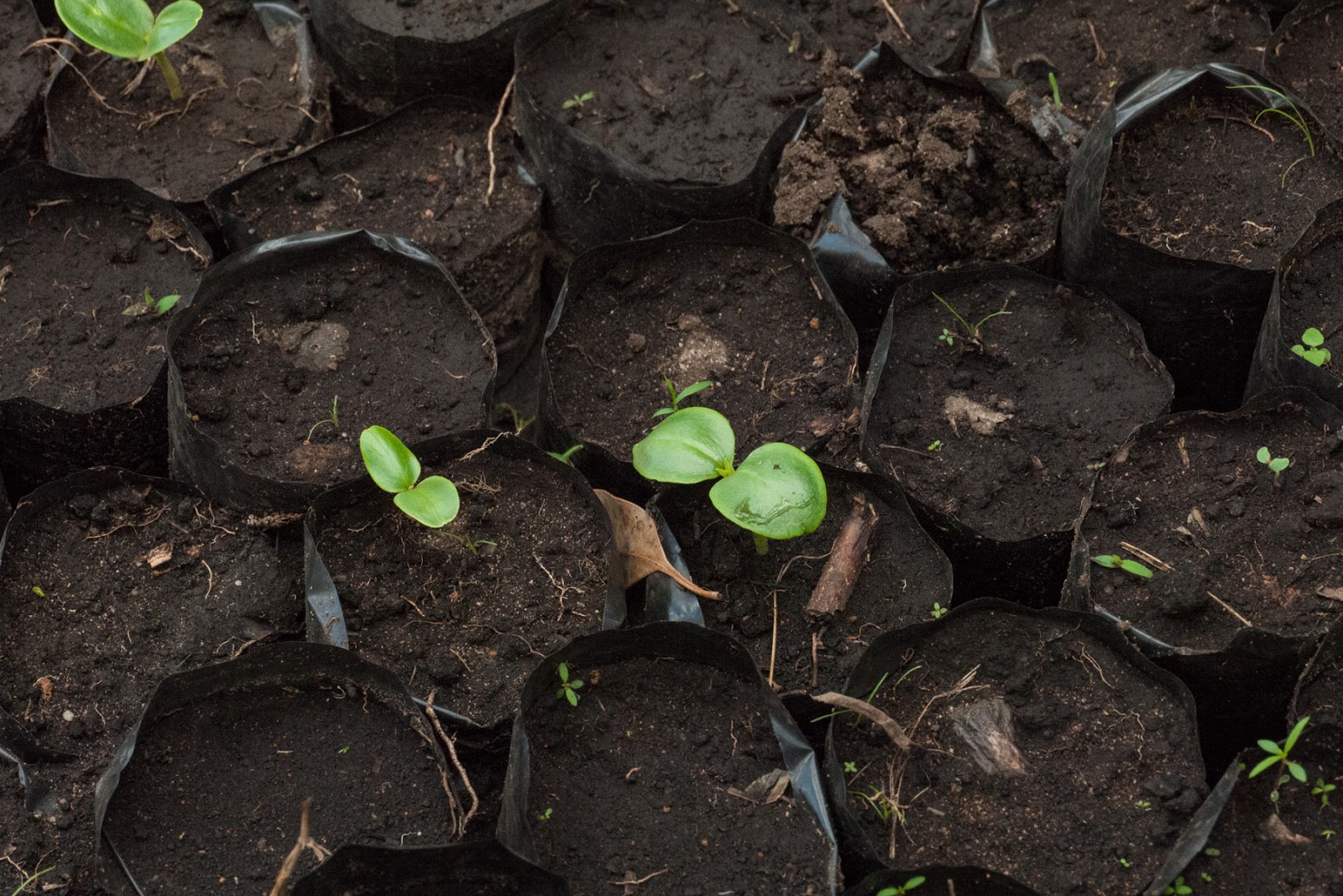
We've started a new project to help protect a watershed area called Nyakazu. This is a priority area for the country since it has value both for it's biodiversity and for tourism. There's a spectacular canyon which I've talked about before where there is a residual native forest. A community nursery was recently started where local people went and gathered tree seed from the forest and are trying to propagate them here. Below is one of the species, called Umuvyiro (still looking for the scientific name). This is one of the few times this has been tried and it's really an experiment to see what will grow and what will not. So I'm very excited to see these leaves pushing through after 6 weeks in the ground. Makes me want to move here and just work on getting native trees to propagate. In a few months time these trees will be planted in and around the canyon area--the community (and our) first attempt at native tree propagation.

Sunday, October 20, 2013


Saturday, October 19, 2013

Wednesday, October 16, 2013

Tuesday, October 15, 2013
This is a classic agroforestry plot in Kilimanjaro Tanzania. A mixture of banana, avocado, some timber trees, and annual crops (at this moment, maize). There's also one sad, spindly looking coffee plant (sort of in the middle of the picture, slightly to the left of centre). The groups with whom we work here have done significant tree planting and recently I was able to do a quantitative analysis of whether all that tree planting has resulted in any measurable change or not. The graph below shows the change in vegetation--measured as an index called NDVI--over a 3 year period. What it shows is at locations where there are groups working to do tree planting, there has been an increase in vegetation over time. As you move away from the centre where the group is located, there is still a positive influence but less so with distance. At about 5 or 6 kilometres away from where these groups are located, the change in vegetation starts to become negative. This is shown in the green line. The yellow line shows what happens around a typical village in the rest of the same watershed. You can see that change at and around these villages is negative over the three years, and gets worse further away from the village.


Monday, October 14, 2013
the Nairobi airport. which frankly doesn't look
 that much different since the last time i was here (when was that? i guess i should check my blog). You may remember there was a big fire here a few weeks back and there are definitely sections that are closed off for repair but things appear to be working more or less OK. In fact i got my transit ticket printed off faster than ever. So fast I thought maybe they'd made a mistake.
There is a subtle smokey aroma in the air

There is a subtle smokey aroma in the air
Thursday, July 18, 2013
It is slightly less hot this evening. Or less humid. Plus I had fresh mango and passion fruit juice. So life is good.
One more day of meetings tomorrow. These have been interesting, but with some intense moments. When I'm in listening and translating mode it's always a bit draining for me even if the discussion itself is fairly tame. Internally my brain is going a hundred miles an hour to try and keep up with the conversation. It's a good feeling though. Tiring but kind of like the tired you get from a good run.
One more day of meetings tomorrow. These have been interesting, but with some intense moments. When I'm in listening and translating mode it's always a bit draining for me even if the discussion itself is fairly tame. Internally my brain is going a hundred miles an hour to try and keep up with the conversation. It's a good feeling though. Tiring but kind of like the tired you get from a good run.
Wednesday, July 17, 2013
Monday, July 15, 2013
Three years after the Haiti earthquake and I'm still learning about things that happened during those few seconds. One of the staff here who drives for us was telling me about how his wife was trapped in a building and had her leg crushed. It was several days (I'm not entirely clear on exactly how many), before they could get her to a functioning hospital that was in any kind of shape to look after her, and by then it was too late. Infection had set in and they were forced to amputate below the knee. My co-worker said one of the worst things was that he and his wife were in desperate need but everyone they turned to was in the same situation. Fortunately my co-worker has family in the US, and they were able to get his wife there where she received a prosthetic limb. Then my co-worker asked me where I was during the Haiti earthquake.
"At home reading the news on the internet." my pathetic reply.
I think both of us at that moment were thinking about how life is horribly, brutally unfair, but nobody said anything.
"At home reading the news on the internet." my pathetic reply.
I think both of us at that moment were thinking about how life is horribly, brutally unfair, but nobody said anything.
Friday, June 14, 2013

I'm in the Vienna airport. The layover was only 5 hours and I kind of thought it would be better to just sit and relax. But I sat there thinking about it for about a half hour then grabbed my bags and headed through customs. There's a direct train to the city centre that takes 16 minutes. I didn't really have a plan and didn't have long anyways so it was really just a stroll around the city centre. I passed a couple of nice cafes that I should have stopped at but kept thinking I would find a nicer one. Which was a mistake since I never did and had to get back on the train without drinking Viennese coffee. Next time Vienna!
Wednesday, June 12, 2013
There are many communities here that have extremely uncertain land situations. They may have been living here for 20 or 30 years, but new national parks and forest reserves keep getting established, the laws are unclear, and generally people's futures are just up in the air. You can see it in people's eyes when we are talking to them. They just don't know if they might get kicked out of their homes tomorrow. But a good news story: one of the villages we visited has recently struck an agreement with the local authorities to implement agroforestry plots on forest reserve land. The first photo shows a young agroforestry plot started by one farmer. This has rattan, fish tail palm, fan palm and several other species that are at the same time forest species but also can help families feed themselves and make a living. The owner of the plot is eating and selling food products as well as shingles made from palm leaves. The forest dept took notice, and after some negotiation, has agreed to have villagers try out these innovations on about 3 hectares of reserve land. The second photo shows part of that area where this will soon be happening. It's the classic win-win scenario. Farmers get to feed and cloth their families, and the park gets greener, better protected land.


Pigs are an excellent way for a family here to supplement their income and diet. Lots of small scale farmers do raise pigs, but there area couple of interesting things that UHDP (the organization we are partners with) does to help farmers with that. One is that they loan a sow to a farmer. When there are piglets, the farmer has to pay back the program with two pigs for the one he or she receives. This is a popular animal loan model originally developed by Heifer Project, but now used by programs around the world. In this way, the farmer gets a pig for very low cost, and the program gets to keep distributing more animals. The second thing is that UHDP promotes composting pig pens.

Subscribe to:
Posts (Atom)