Sunday, October 23, 2022

 Time to change to winter tires. It's 15 degrees C today which makes me feel a bit silly putting on winter tires, but it is the end of October, and it is Ontario. You know what they say in Ontario, "if you don't like the weather, wait 5 minutes". If you change your own tires, a couple of things I've learned:

1. get a tire cart. I used to roll my tires out to my car from storage, but that is a pain and the tires keep escaping as they roll. A 60 dollar tire cart just takes the hassle out of it.

2. you can used a bicycle pump to inflate car tires. With the cheap pump I have, 1 full pump is almost exactly a quarter of a pound, so 4 pumps is 1 psi. When I put on the winters just now, they were all around 26 psi, so about 24 pumps was required on each tire. 


Summer tires tucked away til next year...


Thursday, December 24, 2020

I started out last night listening to Christmas music but meandered as I often do in this algorithm based world, and I ended up here. Far from appropriate for the season, you might say, and about events long ago, and far away. Sometimes though, a song captures a feeling, a spirit of something, that I am trying to express and says it better.

In this case, trying to make sense of a world that doesn't seem to make much sense.

Later in the evening I got here. The same artist wrote this song a few years later; a response to the feelings and emotions expressed in the first song--searching for hope instead of anger. At least that is the way I like to think about it.

I know I am not the only one looking for hope in a chaotic world. That is the spirit of this season and my prayer for you (and myself).


Thursday, October 01, 2020

 Every year, the organization I work for hosts a big gala event. This year, like many, we are having to adapt and are holding a virtual event. There will be several talks and other events and unlike in the past, you wouldn't have to go to San Diego to attend.

If you want to know more here's the link:

https://plantwithpurpose.org/gala2020/

I am one of the speakers as well, so check the schedule if you want to hear more in particular about our watershed approach, climate change and how it affects farmers, or how we measure impact. There are several other talks as well so you can avoid listening to me altogether if you choose!

Sunday, March 08, 2020

On the flight home, when breakfast was served, the Ethiopian Airlines flight attendant asked me if I wanted eggs, pancakes, or ful. Normally I find airplane breakfast uninspiring but my ears perked up when she said ful. This is a bean dish cooked with pepper and other spices and is usually served with fresh baked bread. Really delicious. So right away I asked for the ful. Then very next second though, I thought, "Oh, they would never serve ful on an international flight, she must have meant "full" as in eggs plus pancakes." I figured I was having one of those weird cultural transition moments, not quite knowing what context I was in and hearing something from the wrong place or time. So imagine my delight upon opening the foil lid to discover that, a) I had heard things correctly, and b) I was going to get to enjoy ful one last time on this trip. I was so excited I almost went back to the service area to tell the flight crew that was the best airplane breakfast ever but I thought they might think I was a crazy person. Seriously though, best airline breakfast ever.

Thursday, March 05, 2020

A native species of olive that is often found in church forests. We are planting thousands of these to help reinvigorate these forests which are often centuries old but experiencing heavy encroachment from neighbouring farmland

Sunday, March 01, 2020

Frankincense. Yup, same as the 3 wise men. Part of drinking coffee in Ethiopia


Saturday, February 29, 2020

This morning I uploaded this file--a geospatial pdf. This shows 3 watersheds in Ethiopia and lets the user check their phone and figure out where they are relative to watershed boundaries. Why would I want to do this? Knowing where you are in a watershed is important to planning for example for tree planting activities. The upper parts of a watershed tend to be especially critical and are often the source of rivers that supply water to the rest of the system. Knowing where you are then means you can decide where is best to plant and what is best to plant. A simple file like this, easy to read on any phone can help farmers make the best use of their time and resources in restoring the environment.


Saturday, December 21, 2019

It is hard for me to believe that someone of such great integrity like the late Reverend Billy Graham would support someone of so little integrity like Donald Trump. That just doesn't compute for me.

Friday, July 19, 2019

Chips Mayai. Basically a French fry omelette and a common local dish. So a travel tip: if you are looking for something reliable, fast, and not a stomach risk. I would say order chips mayai. Nearly every restaurant will have it, price will be good, and you can be on your way in a reasonable time.
I mean I don't think anyone is going to see a plate of chips mayai going by and say, "I'll have what they're having.", but it's a case of the safe bet over culinary adventure.

One of the brand new groups we surveyed this week have decided that their group name is Yes We Can. Hearing that actually brought a tear to my eye, realizing the hope that this group has and the optimism about what they can achieve. Also it is encouraging that the words of a world leader can still inspire in a time when hatred and hostility seem to be the currency of leadership.


Tuesday, July 16, 2019

Farmers voting in a participatory exercise (focus group) on sources of income. Trying to measure income is elusive, kind of a holy grail of this work. This exercise you see here is a new thing for us and it seems to be a promising balance between amount of work and getting reliable information. Still a lot of field testing to do to prove the concept though...

Sunday, July 14, 2019

It is always such a great feeling to get off the plane, have a shower and just lie down. After hours and hours in a sort of non lieing down stasis.

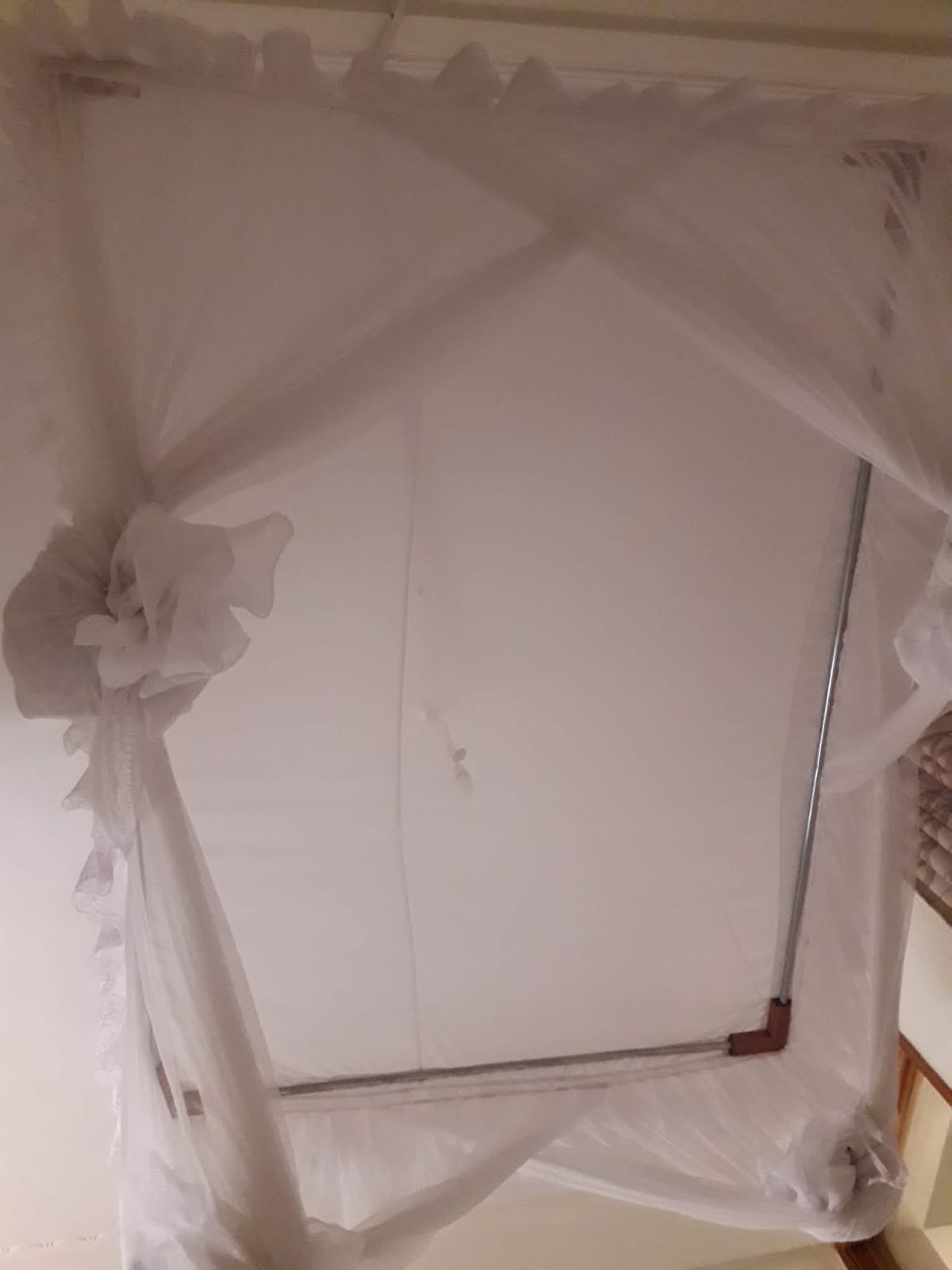
A view of the quality mosquito net in my room

Tuesday, May 07, 2019

Four reasons not to raise the speed limit (in Ontario):
1. Going slower saves lives--the World Health Organization says that if a car hits a pedestrian at 40 kmh, the chance of their survival is 80% but if the car hits someone at 60 kmh the chance of survival drops to 20%.

2. Going slower saves money--performance varies by car, but as a general rule, for every 1 kmh above 90 kmh, fuel efficiency drops by about 1 %. So if you are driving 120 or 130, you are burning about a third more fuel than if you were going 90 kmh.

3. Going slower is better for your car--driving at high speeds puts more stress on the engine, more wear on tires, brakes, which means more repairs, and a shorter lifespan for the car. Ultimately saves money (see #2 above).

4. Going slower is better for the environment--related to #2 and #3, if you are burning less fuel you are producing less pollution and carbon. If your car lasts longer you keep more plastic, electronics and batteries out of landfills and create less demand for mining resources. Driving slower is one practical thing we can do that actually has a significant positive impact on the planet at a personal level.

Tuesday, January 22, 2019

So the Montreal Olympics in 1976 were originally estimated to cost 250 million dollars and ended up costing 1.something billion dollars. I mean does it really matter whether I say 1.2 or 1.7? I'm guessing that if you really looked into it, no one probably actually knows how much it really cost. My point is that that was an overly ambitious, poorly thought out project that appealed to the imagination of many. So if someone says a that a 2000 mile wall will cost 5.7 billion dollars, how much will it really end up costing when all the receipts are tallied? The tallying alone will probably cost hundreds if millions. 
Minus 16 Celsius. I caved in and took a ride to the airport instead of the bus, which would have required me to stand at a bus stop. Meanwhile in Bahir Dar the temperatures are dipping into the low teens at night. Which is chilly by local standards.

Wednesday, December 12, 2018

I don't know if it is the injera or the local chilies (berbere), or maybe all the local coffee I have been drinking, but there is something hard to describe here, an almost mystical quality. I mean, this area is called Gondar for one thing. People here resolutely believe that it was here that Mary and young Jesus fled when escaping King Herod. The Ark of the Covenant, of biblical and movie fame is also believed to be here. In fact the island in the second picture, is where many believe the Ark was first kept after it was taken from Israel. In fact you can see the exact spot where it was kept for several centuries. It actually makes sense to me that if you were trying to protect an object of such significance, one would want to take it to a place where it could not be easily found. And this place certainly fits that description. Way up in the highlands, historically inaccessible and far from major trade routes and then on a tiny island in the middle of a pretty big lake (even today it takes 2.5 hours by boat to get there). I don't know myself but like I say, there is something that makes one want to believe.


Saturday, December 08, 2018

Blue Nile Falls, just downstream from Lake Tana, so quite close to where the river starts. Much of the river is now diverted for hydroelectric power and what you see here is only 25% of the whole thing. Also this is after rainy season so it can get much bigger. The Blue Nile is one of two main tributaries of the Nile, the other being the White Nile, but volume wise, the Blue Nile brings the majority of the water. In fact this creates some water resource management issues between Ethiopia and the countries downstream (mainly Egypt).


A woman serving coffee at the Blue Nile Falls was wearing this coin, an Austrian thaler. First minted in Austria (of course) in the 1700's (you can see the date 1780 on the coin), it was commonly--but not exclusively--used as currency in Ethiopia even into the 20th century. Now worn as jewelry I guess. This coin was almost certainly not minted in 1780 since that date has apparently been stamped on all thalers since that time.

Thursday, December 06, 2018

The first pouring of the coffee ceremony, abol
The second pouring, tona
The third pouring, baraka

Wednesday, December 05, 2018

Alem Saga mountain, in S Gondar region, Ethiopia.