It's the time of year for lists: gifts, resolutions, top albums of the year, top movies, best books, moments in sports, etc. Not wanting to miss out, I'm providing for you here some of my favourite photo shots from the past 12 months. These appear in the video in chronological order, in case you're curious.
Monday, December 22, 2008
Tuesday, December 09, 2008
Canadian politics
I have a theory about what's going on in Canadian politics right now (you knew I would). The problems we are facing globally are so huge, so apparently insurmountable, that our leaders are subconsciously opting to tackle a theme that seems solveable, something they are comfortable with. They've retreated inside the walls of parliament and it makes them feel better. So instead of addressing what we might do about the conflict in the Congo, or what our role is in Afghanistan, or the increasingly unstable climate, or the global credit crisis, our national leaders have chosen to hold a debate that's more in their area of expertise: non-confidence motions, proroguation, parliamentary protocol. It's human nature I suppose, whenever we are faced with something bigger than us, we focus on a smaller part that we feel we can handle. Of course that is not what we need or expect from our leaders. As I travel all around the globe, I have always been immensely proud to be a Canadian. This particular moment however, has to qualify as my second most embarrassing moment as a Canadian. I want to encourage Canadian leaders from all political camps, please, get on with the business of governing this country, and making us one of the great nations in the world.
Monday, November 17, 2008
v5#5
I'm looking for some advice. I'm not quite sure if it's ethical, moral, legal or what.
You likely know that I travel quite a bit and that I spend a great deal of time in immigration and customs lineups that I would prefer to avoid if I could. Well, I've noticed that a couple of government institutions from a couple of countries which will remain nameless for the purposes of this update are promoting a system where you can avoid the long lines by applying for a special pass for frequent travellers. Of course they put the emphasis on cutting the lines, so recently I applied for said pass, only to discover that, by the way, we'll be scanning your iris in order to ID you when you pass through. As much as I would love to save time in lineups (and I've spent literally hours doing that), the whole thing strikes me as very 1984/Gattaca/Bourne Identity.
So what do you think? Am I selling my soul for a few minutes in line? Or is it just practical way for someone who travels to save time? Please weigh in on the blog comments space if you want. I'm undecided at this point, and your insight would be appreciated.
You likely know that I travel quite a bit and that I spend a great deal of time in immigration and customs lineups that I would prefer to avoid if I could. Well, I've noticed that a couple of government institutions from a couple of countries which will remain nameless for the purposes of this update are promoting a system where you can avoid the long lines by applying for a special pass for frequent travellers. Of course they put the emphasis on cutting the lines, so recently I applied for said pass, only to discover that, by the way, we'll be scanning your iris in order to ID you when you pass through. As much as I would love to save time in lineups (and I've spent literally hours doing that), the whole thing strikes me as very 1984/Gattaca/Bourne Identity.
So what do you think? Am I selling my soul for a few minutes in line? Or is it just practical way for someone who travels to save time? Please weigh in on the blog comments space if you want. I'm undecided at this point, and your insight would be appreciated.
Saturday, September 06, 2008
v5#4
"Are you carrying any ironic items in your pockets, sir?", asked the security officer at the airport checkpoint in rural Ethiopia.
"I don't know, I suppose that depends on your point of view.", I thought. The US dollar bills in my wallet, the ones that say, "In God we trust" on them, some might say those are ironic. Or perhaps the CD by the locally famous pop artist who was recently thrown in prison for writing lyrics mildly critical of the current government, there might be those that see that as ironic. Maybe even the pants the pockets were on, the total value of which is probably close to equivalent to the monthly income of a typical working Ethiopian, surely that might be an ironic item. If I thought about it long enough, probably all the items in my pockets could be ironic in some way or other.
But somehow I managed to keep all that to myself, and only responded,"No, nothing ironic." So my check through security, and my travel from rural Ethiopia to the capital Addis Ababa went without incident. This gave me time for one last cup of coffee, in the very birthplace of coffee. This made each cup an event for me, and I felt compelled to document this photographically as you will see in the attachment or on the blog. And as I sat there, waiting for the long flight from Africa to my homeland in the New World to begin, the sounds of Eric Clapton doing a reggae interpretation of "Swing low, sweet chariot, comin' for to carry me home..." came up on my MP3 player, one more ironic item I should have mentioned to the security guy.
Photo: every cup of coffee I drank in Ethiopia, plus a few coffee related shots.

Tuesday, February 19, 2008
v5#3
I occasionally find myself in that uncertain, hazy space between asleep and awake asking myself, "Where am I?". It's this strange moment which I find both exciting and disconcerting at the same time, when in the next instant it will be revealed if I'm in a hotel in Africa, or on a bamboo mat in Thailand, or perhaps on my couch in Canada. It's not really so much of a conscious thought as it is this feeling that my neurons have not quite fully booted up and connected me with all my peripherals (eyes, ears, nose, etc).
I once in while get a similar sensation when I'm driving, when I'm turning on to a new street and for a very very brief second, my instincts fail me and won't tell me whether I'm supposed be moving to the left side of the road or the right side. Again, it's not so much that I'm thinking about it, usually that stuff is hard-wired, no thinking required, but I guess I've done enough driving in former British colonies to establish two competing driving patterns.
The thing is, there seems to be less and less to tell my senses that one place is different from the next. Cell phones are everywhere, internet is well, not everywhere but many places, satellite TV, fast food, big name shoe brands, large volume retail stores. I might hear the same music in London as I hear in Kilimanjaro, or Port au Prince. This is not to say that every place is the same. There is still this huge and amazing diversity of culture, language, food, music, sometimes just a few kilometres apart in some regions. It's just that there's this superimposed layer of globalized meta-culture (am I using this word properly?) that one seems to encounter everywhere one turns now.
Someone will have to tell me whether this is a good thing or a bad thing for the global community. Myself, I'm just trying to stay out of on-coming traffic, or rolling out of bed face first into some random piece of furniture.
Fast food--Thai style
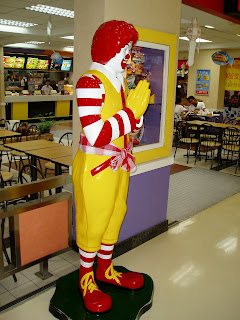
I once in while get a similar sensation when I'm driving, when I'm turning on to a new street and for a very very brief second, my instincts fail me and won't tell me whether I'm supposed be moving to the left side of the road or the right side. Again, it's not so much that I'm thinking about it, usually that stuff is hard-wired, no thinking required, but I guess I've done enough driving in former British colonies to establish two competing driving patterns.
The thing is, there seems to be less and less to tell my senses that one place is different from the next. Cell phones are everywhere, internet is well, not everywhere but many places, satellite TV, fast food, big name shoe brands, large volume retail stores. I might hear the same music in London as I hear in Kilimanjaro, or Port au Prince. This is not to say that every place is the same. There is still this huge and amazing diversity of culture, language, food, music, sometimes just a few kilometres apart in some regions. It's just that there's this superimposed layer of globalized meta-culture (am I using this word properly?) that one seems to encounter everywhere one turns now.
Someone will have to tell me whether this is a good thing or a bad thing for the global community. Myself, I'm just trying to stay out of on-coming traffic, or rolling out of bed face first into some random piece of furniture.
Fast food--Thai style

Saturday, February 09, 2008
v5#2
I want to apologize in advance for this blog entry, because I know it's going to be all over the place. I just got back from my first, around-the-world trip: Burundi, Tanzania, Thailand, USA, then home again. Someone pointed out to me at some point during the trip that by travelling that way (eastward), I have actually gained a day, and am now one day younger, technically speaking than when I left Toronto on Jan 3. I was in Kenya, three times, but just transiting through the Nairobi airport, so I didn't really get a sense for how things are going there. I do know that in both Burundi and Tanzania, it was a major topic of conversation, and as a major trade and political partner, the strife there has a significant effect on the region.
I think for me the most intense portion of the trip was Burundi. I've been preparing for that visit, planning, researching, reading, reflecting, and to be quite honest, working up the emotional energy just to be there for many months now. As many of you likely know, the recent history of Burundi is very similar to that of Rwanda, only on a slightly smaller scale. For a reasonably succinct summary of Burundian history see the US. State Dept website at http://www.state.gov/r/pa/ei/bgn/2821.htm or for a more personal account, read the book This Voice in My Heart by Gilbert Tuhabonye http://www.amazon.com/This-Voice-Heart-Survivors-Forgiveness/dp/0060817518. I also had the chance to visit a memorial built to remember the loss of several hundred school children. Part of the building where they were burned has been preserved and built into the memorial, and as you might imagine, visiting such a site is a profound and difficult experience. Such recent and brutal memories factor into much that is happening in Burundi today, and many organizations who are trying to re-establish basic political and economic stability face issues of peace and reconciliation daily in the communities where they work.
The photo is of part of the memorial, where every year, parents meet and bring flowers. Next to this part of the memorial is the building itself, although I could not bring myself to take a picture.

I think for me the most intense portion of the trip was Burundi. I've been preparing for that visit, planning, researching, reading, reflecting, and to be quite honest, working up the emotional energy just to be there for many months now. As many of you likely know, the recent history of Burundi is very similar to that of Rwanda, only on a slightly smaller scale. For a reasonably succinct summary of Burundian history see the US. State Dept website at http://www.state.gov/r/pa/ei/bgn/2821.htm or for a more personal account, read the book This Voice in My Heart by Gilbert Tuhabonye http://www.amazon.com/This-Voice-Heart-Survivors-Forgiveness/dp/0060817518. I also had the chance to visit a memorial built to remember the loss of several hundred school children. Part of the building where they were burned has been preserved and built into the memorial, and as you might imagine, visiting such a site is a profound and difficult experience. Such recent and brutal memories factor into much that is happening in Burundi today, and many organizations who are trying to re-establish basic political and economic stability face issues of peace and reconciliation daily in the communities where they work.
The photo is of part of the memorial, where every year, parents meet and bring flowers. Next to this part of the memorial is the building itself, although I could not bring myself to take a picture.

Wednesday, January 02, 2008
v5#1
This is actually a 2007 entry that I got in late. And it's about something that took place in September. However, for me it was a noteworthy event so here it is, better late than never I suppose.
In September, I was in Kenya, visiting an organization we are collaborating with on Rusinga Island in Lake Victoria. We were sitting around one evening with various staff and volunteers from this organization, and it was getting pretty late (around 10:30pm, pretty late in rural Kenya), when one of the volunteers--who happens to be fellow Canadian--realized that he had lost the keys to his house. So, the director of the organization, the volunteer, and myself, set off to the volunteer's house to see if we could figure out a way to get him inside. Various ideas were discussed, such as breaking down the door, breaking a window, using a stick to try and fish out the other set of keys locked inside, etc. Once we got there though, a quick tour around the outside told us that getting in through any of those methods wasn't going to work. However, as I looked at the wall of the house, and the gap between it and the roof, I decided that I might be able to squeeze through. First we had to remove the chicken wire which filled that gap meant to keep out bats, birds, rodents etc. Then remembering one of the generally useless factoids I carry around, I tried sticking my head through the gap first as a test. They say that since the head is the biggest bone in the human body, if you can get your head through something, you should be able to get the rest of your body through. My head barely fit through, so, trusting this, I got up on a stool, and started pushing my way in through the wall-roof gap. This was not easy, and the fit was pretty tight, and I scraped my chest and arms in several places as I proceeded. Until I got up to my hips. At this point you have to try and picture (since I have no photo of this fortunately), that I'm half-way in the house, head, arms and torso inside, hips resting on the top of the wall, and legs outside. Getting that far was possible because the upper half of your body curves, and I was able to do this to get underneath the downward sloping roof. But, hey, my legs don't bend backwards and I had this sudden moment of panic as I realized I might not be able to move forward any further, but might also not be able to move backward either. I was visualizing how everyone on the island would be talking about the one Canadian who had lost his keys, and the other Canadian who had got stuck in the wall of the house and how they had to tear the house apart to free him. As a desperate last attempt, I had the two on the outside tear more of the chicken wire away to my left, and then slowly I brought my left leg up to my side, and with some extreme stretching, I was able to get my left leg up and through to the inside. (All that stretching in Aikido actually pays off!). Once my leg was in, the rest was easy, and I swung inside in a few seconds, found the spare key, and passed it out to the director and volunteer waiting outside who opened the padlocked door. When the door opened, the director, a Kenyan, just looked at me and said,"I can't believe you just did that." Who knew my job skills would extend to break and enter?
Photo is of the space I squeezed through; you can see the chicken wire pulled back.

In September, I was in Kenya, visiting an organization we are collaborating with on Rusinga Island in Lake Victoria. We were sitting around one evening with various staff and volunteers from this organization, and it was getting pretty late (around 10:30pm, pretty late in rural Kenya), when one of the volunteers--who happens to be fellow Canadian--realized that he had lost the keys to his house. So, the director of the organization, the volunteer, and myself, set off to the volunteer's house to see if we could figure out a way to get him inside. Various ideas were discussed, such as breaking down the door, breaking a window, using a stick to try and fish out the other set of keys locked inside, etc. Once we got there though, a quick tour around the outside told us that getting in through any of those methods wasn't going to work. However, as I looked at the wall of the house, and the gap between it and the roof, I decided that I might be able to squeeze through. First we had to remove the chicken wire which filled that gap meant to keep out bats, birds, rodents etc. Then remembering one of the generally useless factoids I carry around, I tried sticking my head through the gap first as a test. They say that since the head is the biggest bone in the human body, if you can get your head through something, you should be able to get the rest of your body through. My head barely fit through, so, trusting this, I got up on a stool, and started pushing my way in through the wall-roof gap. This was not easy, and the fit was pretty tight, and I scraped my chest and arms in several places as I proceeded. Until I got up to my hips. At this point you have to try and picture (since I have no photo of this fortunately), that I'm half-way in the house, head, arms and torso inside, hips resting on the top of the wall, and legs outside. Getting that far was possible because the upper half of your body curves, and I was able to do this to get underneath the downward sloping roof. But, hey, my legs don't bend backwards and I had this sudden moment of panic as I realized I might not be able to move forward any further, but might also not be able to move backward either. I was visualizing how everyone on the island would be talking about the one Canadian who had lost his keys, and the other Canadian who had got stuck in the wall of the house and how they had to tear the house apart to free him. As a desperate last attempt, I had the two on the outside tear more of the chicken wire away to my left, and then slowly I brought my left leg up to my side, and with some extreme stretching, I was able to get my left leg up and through to the inside. (All that stretching in Aikido actually pays off!). Once my leg was in, the rest was easy, and I swung inside in a few seconds, found the spare key, and passed it out to the director and volunteer waiting outside who opened the padlocked door. When the door opened, the director, a Kenyan, just looked at me and said,"I can't believe you just did that." Who knew my job skills would extend to break and enter?
Photo is of the space I squeezed through; you can see the chicken wire pulled back.

Saturday, October 27, 2007
my apartment garden

I had these tomatoes out on the balcony all summer and moved them in when it got cold. They are still producing tomatoes and flowering. I'm wondering how long I can keep growing tomatoes indoors like this.
Sunday, October 21, 2007
v4#10
I am pleased to announce that my car just turned 300000 km. I know that many cars have done this, and some last much longer, but this is mine, and I have invested some time and effort in keeping this 93 tercel alive (with a little help from my friends). For the past week or so, I've kept my camera in my car to capture the moment. It happened early Friday morning and I had to pull over on the 401 in Brampton to get the shot. What's really satisfying, at least this year, is that since January, I've spent exactly 30.62 dollars on maintenance (that's 31.54 for my American friends).


Saturday, September 15, 2007
v4#9
Translating from Swahili to Haitian Creole is a strange thing to say the least. It would help of course if I was a better speaker in either language, but some reps from the organization I work for from Haiti are attending this training course on Jatropha curcas in Tanzania, and I happen to be the person available to provide what little help I can. I really wish I was better at it because I feel like there's something very significant about two people coming from Haiti, an island country populated by people of African origin, and still in many ways living as their ancestors did. So somehow I feel like when I get the occasional chance to hear something in a true African language and turn and express this in a Caribbean language which evolved through some remarkable history, its like maybe in some microscopic way I make a contribution to undoing all the bad karma accumulated by my European ancestors in creating and promoting a way of life which was based on slavery for many centuries.
Maybe that just sounds like crazy talk to you, but I swear I can almost hear the voices of many who have gone before, African, Caribbean, and European very close behind, or perhaps, above.
Again I am photoless this month which I will rectify as soon as I get home.

Simple lamp made from coffee can burning on jatropha oil. Oil is pressed from the seed of the jatropha plant and burned directly. One of the many uses of jatropha we learned about during the course.
Maybe that just sounds like crazy talk to you, but I swear I can almost hear the voices of many who have gone before, African, Caribbean, and European very close behind, or perhaps, above.
Again I am photoless this month which I will rectify as soon as I get home.

Simple lamp made from coffee can burning on jatropha oil. Oil is pressed from the seed of the jatropha plant and burned directly. One of the many uses of jatropha we learned about during the course.
Tuesday, August 21, 2007
v4#8
I see in the news that it is reported that 2 or 3 people died in Haiti during Hurricane Dean. I want to assure you that I was not one of them.
I spend most of Saturday at our office in Gran Goav, about 75km outside of Port au Prince waiting for the hurricane to arrive. The brunt of the storm passed to the west of where our office is located, but still there were strong winds, and an insistent, cold pelting rain that forced it's way through every opening and crack in the building where I was taking shelter. It also knocked over our large iron gate, which I have a photo of, but am unable to send from this internet cafe. The actual hurricane itself did not arrive until about 2 or 3 in the morning on Sunday, and then lasted the rest of the night until late Sunday evening. Today, monday, the sun is out again, and everyone is assessing the damage. In our area, this is mostly knocked over trees, and lost banana crops, which although not life threatening will seriously hurt many farmers incomes. I myself was never in any danger. I think that Dean was categorized as class 4 and where I was was on the milder outer edges. I would really hate to be in the centre of a class 5. A tornado, on the other hand, that I would like to see, from some safe distance of course. 

I spend most of Saturday at our office in Gran Goav, about 75km outside of Port au Prince waiting for the hurricane to arrive. The brunt of the storm passed to the west of where our office is located, but still there were strong winds, and an insistent, cold pelting rain that forced it's way through every opening and crack in the building where I was taking shelter. It also knocked over our large iron gate, which I have a photo of, but am unable to send from this internet cafe. The actual hurricane itself did not arrive until about 2 or 3 in the morning on Sunday, and then lasted the rest of the night until late Sunday evening. Today, monday, the sun is out again, and everyone is assessing the damage. In our area, this is mostly knocked over trees, and lost banana crops, which although not life threatening will seriously hurt many farmers incomes. I myself was never in any danger. I think that Dean was categorized as class 4 and where I was was on the milder outer edges. I would really hate to be in the centre of a class 5. A tornado, on the other hand, that I would like to see, from some safe distance of course.


Sunday, July 22, 2007
v4#7
So many pictures to choose from this past trip, I don't know which one to send you. I'll post more on the blog. One of the main purposes of this most recent trip to Haiti was to initiate plans for a new project in a new region of the country. Suddenly, it seems the whole world is going 'green' and in the past 6 months several organizations have approached us for help with reforestation or agriculture projects. This is great news for us of course, but we're a) small, and b) not used to the attention, so we're hoping to be able to meet the new needs, but not over-extend ourselves. How this affects me personally is that I am travelling even more than before. As you may have gathered from last month's update, I find the reaction of the immigration officers to my passport somewhat amusing. It makes what is otherwise a mundane process into something slightly entertaining. When I hand my passport over the counter, the typical reaction is that the officer takes with an air of exceeding boredom, looks at my photo like they've seen a thousand today (probably have), and then starts to flip through pages looking for a place to put their stamp. This page flipping get's more and more anxious (if an immigration officer could ever be described as anxious), and by the time they get to page 20 or so, they're usually paying a lot more attention. On my most recent transit through Miami on Thursday, after finally getting to an open page, the officer said,"What's your occupation, man?" 


View from my hotel during a Haitian national environmental conference.

A plot treated with soil conservation and tree planting for 7 years on the right, and untreated plot on the left. You can see how much soil has been lost on the left.

A vodou pilgrimage. Thousands of followers come to this pool looking for blessing and good luck from this potent water

The site of the last battle between Napoleon's troops and the victorious Haitian slaves.

In the DR, harvesting pineapple.
Tuesday, June 19, 2007
v4#6
I'm back from my 6 weeks in Northern Thailand. Just got in Monday night as a matter of fact. Here's an excerpt from my conversation with the immigration officer in Pearson Airport (around 11 pm--eastern standard time--I have no idea what time my body thought it was having been on an airplane for the better part of 40 hours):


Playing Takrah in Burma. This is like volleyball but played with the feet. Turns out I'm not very good.

IO: "How many checked bags do you have?"
Me: "Zero."
IO: "You have no checked bags? Where do you pack your clothes?"
Me (picking up my carry-on bag and brief case): "Everything is right here."
IO: "So do you travel a lot for work?"
Me: "All the time."
IO: "OK, well, welcome home."
I had the opportunity to be involved in so many different activities during the 6 weeks. The bamboo experiment, marketing issues, planning, training, credit, etc. It kept the time busy and interesting. The last week was spent at an agricultural conference hosted by ECHO (http://www.echonet.org/), which is a great organization for those of you that haven't heard of it.
There's good people working for our partner organization and I was sorry to have to leave. The good thing about my job is I get a chance to go back.

For some reason it's hard not to take pictures of rice paddies

Late night meeting in a Palong village

A forest mango identified as sacred by the local community

A forest mango identified as sacred by the local community

Some sort of Buddhist cemetary in Burma

Playing Takrah in Burma. This is like volleyball but played with the feet. Turns out I'm not very good.

Sprouting Giant Bamboo (although no sign of roots when this shot was taken)
Sunday, May 20, 2007
v4#5
This trip to Thailand was the product of months of back and forth discussion and planning between our partner organization here (UHDP--Uplands Holistic Development Project) and us (Floresta). So I wouldn't say I was nervous, but I did feel some pressure before arriving. We planned a number of activities and I feel like the outcome of those activities will very much set the tone of the partnership between the two organizations.
One of the things we planned was a participatory workshop with a group of farmers to talk about a particular bamboo species (Dendrocalamus giganteus, or Giant Bamboo). The supply of Giant Bamboo is limited, and it's propagation difficult, so we sat down with farmers from a village called Pang Deng Nai to talk about ways we might resolve the propagation problems. For those of you unfamiliar with participatory techniques, these are tools used in community development basically to help discussion and to encourage communities to take charge of their own development. If you want know more about participatory techniques, there's numerous books, articles and websites available with more information which I can send to you.
So we spent the morning and afternoon talking, and then together came up with a plan for small experimental trial to test various ideas and see if we can't improve our ability to propagate this somewhat elusive species. We stayed in Pang Deng Nai overnight, and the next day set up the experiment with the group of farmers. We should know in a couple of months if anything we tried worked or not, and although I will not be in Thailand at that time, I'm excited about what's happened so far, and eager to hear how the trial turns out.

Discussing Giant Bamboo propagation

Lunch is served.

The trial design with input from farmers and UHDP staff

Preparing to collect Giant Bamboo propagating material
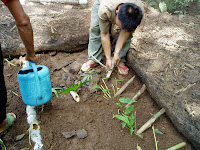
Setting up the propagating material
One of the things we planned was a participatory workshop with a group of farmers to talk about a particular bamboo species (Dendrocalamus giganteus, or Giant Bamboo). The supply of Giant Bamboo is limited, and it's propagation difficult, so we sat down with farmers from a village called Pang Deng Nai to talk about ways we might resolve the propagation problems. For those of you unfamiliar with participatory techniques, these are tools used in community development basically to help discussion and to encourage communities to take charge of their own development. If you want know more about participatory techniques, there's numerous books, articles and websites available with more information which I can send to you.
So we spent the morning and afternoon talking, and then together came up with a plan for small experimental trial to test various ideas and see if we can't improve our ability to propagate this somewhat elusive species. We stayed in Pang Deng Nai overnight, and the next day set up the experiment with the group of farmers. We should know in a couple of months if anything we tried worked or not, and although I will not be in Thailand at that time, I'm excited about what's happened so far, and eager to hear how the trial turns out.

Discussing Giant Bamboo propagation

Lunch is served.

The trial design with input from farmers and UHDP staff

Preparing to collect Giant Bamboo propagating material

Setting up the propagating material


Tuesday, April 17, 2007
What is this??

Last month I was in the Dominican Republic. While out in the field one day this helicopter flew over with this strange looking apparatus. I have no idea what this is, although this region is known for it's mining activities, so me and my Dominican co-workers guess that it might be somekind of prospecting equipment. If anyone knows, or has an educated guess, your comments are welcome.
v4#4
Last month I mentioned a community savings and loan system called VICOBA, short for Village Community Bank. I thought maybe this month I could just give you a brief description of what VICOBA is and how it works.

What is VICOBA? VICOBA is a savings and loan system we are promoting amongst farmers in the Kilimanjaro region of Tanzania. VICOBA, and similar systems are now being used throughout Africa with great success. VICOBA groups are community based, and typically rely on no outside money. A group (in our case, typically 30 people), will get together, draft they own bylaws, elect their own leaders, and initiate a short term investment cycle which lasts one year or less. In our case, we (Floresta) provide intensive training to the group for several months before the investment cycle is initiated and continued training and followup during the investment cycle.
How does the investment cycle work? At the beginning of the cycle, every member deposits an amount pre-agreed upon by the group. Every week after that, the group meets, and at those meetings every member is required to deposit at least one share in their savings account. Again, the share size is pre-determined by the group and written into the bylaws. The group then takes this fund (which increases every week), and uses it to make loans to individual members. Loans are typically for less than 6 months and at a locally competitive interest rate. In addition to interest from loans, groups will also increase their capital by the collection of fines on bylaw infractions (eg. being late to a meeting will cost you around 1 dollar US), and through fund raising events which the groups themselves organize.
What happens with all this money? Well, it's kept in a box. This is a heavy metal box with three locks on it, and the group selects three reliable members to be keepers of the three keys. At every meeting the box is brought out of hiding by the three members, and all the cash inside is counted. The meeting then opens and members deposit their weekly shares. At the end of the meeting, the cash is recounted, and the boxed relocked by the three key-keepers in the presence of the entire group. Transparency is a big deal in VICOBA as you can tell.
What's the success of this? I would have to say pretty remarkable. For example, in a recent investment cycle (the graduation which I mentioned last time), one member invested the Tanzanian Shilling equivalent of 141 US dollars over the 12 month period, and at the end of the cycle received the approximate equivalent of 160 US dollars. This works out to about a 13.5% return. I should point out that not every member invested as much, but every member would benefit from the 13.5 percent return. This type of result is drawing quite a bit of local attention, and even some imitation groups.
Photo is the VICOBA savings box being opened at the beginning of a meeting

Thursday, March 15, 2007
v4#3
Working cross-culturally, I think, is a bit like driving too fast in traffic. If you stop paying attention even for a second you may end up driving off the road, or end up in a big crash. Even if you do manage to stay in control, other drivers will look at you and ask,"What in the world is he doing?" Such is the nature of my work that I live with the constant possibility of a major faux pas, hoping to avoid it, but realizing the embarassing inevitability of it all.
Two weeks ago, I had the opportunity and privilege to attend a meeting of a savings and loan group in Tanzania. The system that this group is using is called VICOBA short for VIllage COmmunity BAnk. Perhaps in another entry I will describe VICOBA in more detail, but suffice it to say that it is working very well, and generating considerable local interest. So much so, that this small community, with a mere 30 VICOBA members, took it upon themselves to invite the District Commisioner. There is no North American equivalent of DC, but he would be just one notch below Governer or Premier. He's important enough that when people walk in the room where he is present they will hold their hand to their heart and bow slightly. So having the DC attend was a surprise for me and a big deal for everyone. In the presence of such dignitaries I am a very minor character, so I was further surprised when I got invited to the head table. And so, in my moment of personal obliviousness, I moved to the next available seat at the head table which also happened to be the central seat, the place of highest honour, definitely intended for the DC, very definitely not intended for me. Worse, having plunked myself down, I had no graceful way to extract myself and had to endure the next 2 hours of my own folly. Luckily, everyone was very diplomatic and managed to pay proper homage to the DC while not causing further embarassment to me (at least not any more than I was already inflicting on myself).
I do have a photo documenting this error, but refuse to post it as I believe my soul may be trapped in there. Instead I am including a photo of a VICOBA member receiving congratulations from the DC himself.
Two weeks ago, I had the opportunity and privilege to attend a meeting of a savings and loan group in Tanzania. The system that this group is using is called VICOBA short for VIllage COmmunity BAnk. Perhaps in another entry I will describe VICOBA in more detail, but suffice it to say that it is working very well, and generating considerable local interest. So much so, that this small community, with a mere 30 VICOBA members, took it upon themselves to invite the District Commisioner. There is no North American equivalent of DC, but he would be just one notch below Governer or Premier. He's important enough that when people walk in the room where he is present they will hold their hand to their heart and bow slightly. So having the DC attend was a surprise for me and a big deal for everyone. In the presence of such dignitaries I am a very minor character, so I was further surprised when I got invited to the head table. And so, in my moment of personal obliviousness, I moved to the next available seat at the head table which also happened to be the central seat, the place of highest honour, definitely intended for the DC, very definitely not intended for me. Worse, having plunked myself down, I had no graceful way to extract myself and had to endure the next 2 hours of my own folly. Luckily, everyone was very diplomatic and managed to pay proper homage to the DC while not causing further embarassment to me (at least not any more than I was already inflicting on myself).
I do have a photo documenting this error, but refuse to post it as I believe my soul may be trapped in there. Instead I am including a photo of a VICOBA member receiving congratulations from the DC himself.

Saturday, February 17, 2007
v4#2
Every morning while I was staying in the Dominican Republic in January, I would get up, leave the hostel where I was staying and head one block down to the local breakfast stand, basically a white cart, wheeled to the curb in the mornings by an older couple. I would order an egg empanada, which was made by taking a pre-made flour tortilla (presumably made up by the wife the evening before, since there was always a stack of about 100 by the time I arrived), folding it in half, rolling up the edges and patting gently with a fork to seal, leaving only one end open. An egg was then cracked so that a dime sized hole was opened on the end, the contents stirred to break the yolk, and poured into the open end of the tortilla. This was immediately sealed and the whole thing dropped into the already hot oil. A few minutes later, the cooked empanada was fished out with a metal skewer and set on rack to allow the oil to drip and the empanada to cool. 10 pesos. Or about 30 cents US. I know that economies differ regionally, but it still amazes me how some people can make a living when their margin can't be all that large. Even a local Dominican restaurant, far from the tourist traffic will charge 3 to 4 dollars US for lunch. Compared to a fast food place in Canada, we're not talking magnitudes of difference. I guess it always makes me wonder if economies of some regions aren't existing in some sort of unrealistic bubble. And when I read that North America has 5% of the world's population, and uses 35% of the world's energy, well, for somebody's economy, a bubble-bursting is probably in order.
Photo: Not breakfast. Worm composting in the DR which can increase yields and quality of vegetables, reduce costs and environmental damage by decreasing the farmer's dependence on chemicals, and be a source of income since the compost itself can be sold.

Photo: Not breakfast. Worm composting in the DR which can increase yields and quality of vegetables, reduce costs and environmental damage by decreasing the farmer's dependence on chemicals, and be a source of income since the compost itself can be sold.

Sunday, January 21, 2007
v4#1
All over Hispaniola is the answer this month. I landed in Port au Prince the first week of January, travelled south to our project site which was established 10 years ago this coming May (the local Floresta staff will be holding a big celebration), then this past week I was visiting our new site straddling the Haiti-DR border. In contrast, the border project (or more correctly, the Trans-Border project) officially started in Sept. 2006. It's inspiring to me to see our Haitian and Dominican staff reaching out to each other, trying to learn each other's language, understand each other's customs, share their experiences and problems together, struggling against the currents of 500 years of mutual history (Columbus landed in Haiti on his first trip) most of which has varied between being hostile and being violent.
Speaking of violence, after an exceptionally dangerous December, this January in Port au Prince turned out to be one of the calmest anyone can remember in a while. Which means there was little risk to me personally (phew!). This is in part being attributed to a new campaign by the government to put police in the street to control things, and I did in fact see officers at most major intersections, something I haven't seen in the past.
I've left the border region now, crossed over land to the Dominican capital Santo Domingo, although not before I and our other staff were subjected to the somewhat chaotic Haitian and Dominican immigration offices, where I was cussed out by a tout for refusing to pay him a 'gratuity' for 'helping' me get my visa stamp.
But perhaps I've already said too much.
Photo is me standing in the market in Fond Verettes.

Speaking of violence, after an exceptionally dangerous December, this January in Port au Prince turned out to be one of the calmest anyone can remember in a while. Which means there was little risk to me personally (phew!). This is in part being attributed to a new campaign by the government to put police in the street to control things, and I did in fact see officers at most major intersections, something I haven't seen in the past.
I've left the border region now, crossed over land to the Dominican capital Santo Domingo, although not before I and our other staff were subjected to the somewhat chaotic Haitian and Dominican immigration offices, where I was cussed out by a tout for refusing to pay him a 'gratuity' for 'helping' me get my visa stamp.
But perhaps I've already said too much.
Photo is me standing in the market in Fond Verettes.


Sunday, December 17, 2006
v3#12
This month I got the chance to teach a field course in Belize. The topic was sustainable community development (unit II). The students were university students from all over the US that spend a semester in Belize. Every week a different instructor is brought into the field campus to instruct on a variety of topics and my week came up in the middle of November. I stressed about this for months since this was the first time I had taught a course, and there were a number of things that had to come together in order for it to be successful.
Well, my first time in Belize, and I found it surprising in many ways. Culturally diverse, sparsely populated, and strongly linked to the global economy. Definitely a place to go back to.
The course turned out pretty well by the way. Well, at least I didn't hear the students complaining too much, and as one of the teaching assistants told me, no negative feedback is the student equivalent of positive feedback.
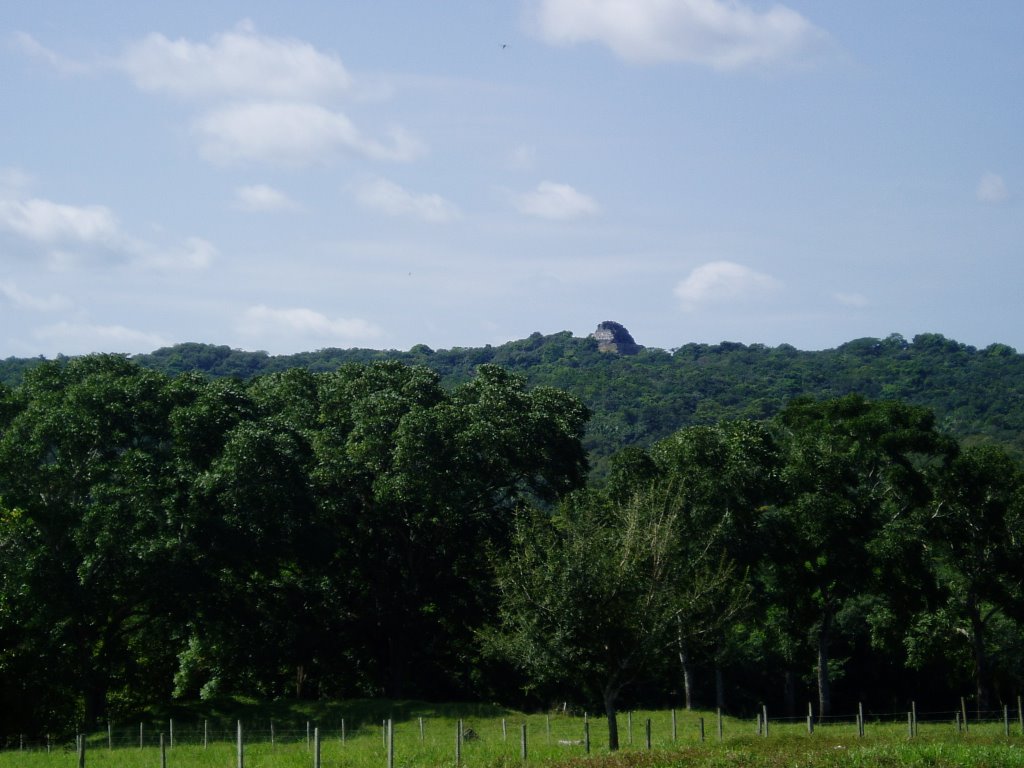
Photo is the main pyramid at the Mayan ruins of Xunatinich visible from the school's campus.

Well, my first time in Belize, and I found it surprising in many ways. Culturally diverse, sparsely populated, and strongly linked to the global economy. Definitely a place to go back to.
The course turned out pretty well by the way. Well, at least I didn't hear the students complaining too much, and as one of the teaching assistants told me, no negative feedback is the student equivalent of positive feedback.
Photo is the main pyramid at the Mayan ruins of Xunatinich visible from the school's campus.
Subscribe to:
Posts (Atom)